Alabama Rot in Dogs: Causes, Signs & Treatments (Vet Answer)

In this article
Two words that have been the source of great stress and anxiety amongst vets and dog owners: Alabama rot. More correctly known as cutaneous and renal glomerular vasculopathy (CRGV), Alabama rot has been recognized in America since the early 1980s, but its more recent, mysterious appearance in the United Kingdom has led to renewed awareness and concern about this deadly disease. Although CRGV is an extremely rare condition, there is very little known about where and how it spreads, which, combined with its high mortality rate, makes it a disease worth knowing about.
Successful treatment of CRGV depends on early recognition and diagnosis, so although the chances are very slim that you will ever see a case of Alabama rot, it’s worth knowing what to be on the lookout for.

What Is Alabama Rot?
Cutaneous and renal glomerular vasculopathy (CRGV) was first seen in racing Greyhounds from kennels in Alabama, hence its common name. Initially, the disease was believed to affect the Greyhound breed exclusively, but this has since been proven incorrect. When it was first described in 1985, the cause of the disease was not known, and this remains to be the case. Several possible bacterial infections have been implicated, including E. coli, Streptococcus, and Rickettsia, but none are believed to be the primary cause of CRGV.
There have been very few cases in the United States since its initial appearance, but the disease has been diagnosed in parts of Europe and the United Kingdom since 2012. Since that time, 324 cases have been recorded in the UK at the time of writing, with 15 of those occurring in 2024.
Although the term “outbreak” has often been used to describe the appearance of new cases, in most instances, only one or two dogs have been diagnosed in a single area, making it difficult to recognize any patterns in how the disease is spread.
One possible commonality to all cases is a recent exposure to cold, muddy conditions, such as woodlands.

Why Is There So Little Information?
Fortunately, there have been very few cases of CRGV over the past forty years; so few that we have been unable to find the exact number in the US. The downside to this is that this also means fewer case studies, laboratory results, and treatment trials. Scientists have been unable to confirm where or how the disease lives in the environment, or how it infects dogs, so there have been no experimental cases to further our knowledge.
What Are the Signs of Alabama Rot?
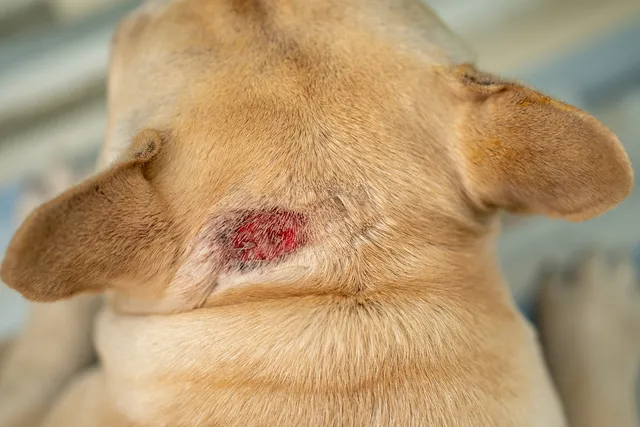
The first sign of CRGV is the appearance of painful, ulcerated lesions on the body. They’re most commonly found on the legs, muzzle, and abdomen but can appear anywhere. The trouble is that these lesions can look like many other wounds, infections, or skin conditions.
These ulcerative lesions are the result of microscopic damage to the blood vessels and surrounding tissue caused by tiny blood clots (microthrombi) accumulating in the walls of blood vessels. In some dogs, the disease does not progress beyond these superficial wounds. However, in many cases, this damage starts to affect the vessels of the kidneys, causing severe, usually fatal, kidney (renal) damage.
Initially, the dog is otherwise well, but as the disease progresses, other clinical signs may appear, including:
There is no specific test for CRGV, and diagnosis is based on a combination of the external lesions and indicators of renal damage on blood tests, with the presence of other cases in the area increasing the likelihood. Biopsies of the lesions are sent for histopathology to confirm the presence of microthrombi in the tissue, but due to the rapid progression of CRGV, if there is a high enough suspicion of the disease, aggressive treatment is generally started before a diagnosis is confirmed.
A more definitive diagnosis usually depends on post-mortem examination of tissue from the kidneys, so a proactive approach to treatment is preferred!
If you are concerned about the health and well-being of your pet, seek veterinary advice for the best course of action.
How Is It Treated?
If CRGV is suspected, the primary aim of treatment is to support the kidneys and prevent the formation of microthrombi. This is achieved by administering intravenous fluids and blood thinners, usually aspirin. Although the wounds are usually slow to heal, they do not usually require any aggressive treatment beyond pain relief and normal wound management.

Frequently Asked Questions (FAQ)
What Is the Prognosis for Dogs With Alabama Rot?
For dogs that only develop skin lesions, the prognosis is excellent. If the disease progresses to renal damage, the success of treatment depends on how severe the damage is, how quickly the disease progresses, and how soon treatment is commenced.
For dogs showing only early stages of renal impairment, the prognosis is usually good, but for those that have developed more advanced renal damage, death is almost a certainty.
How Can I Stop My Dog From Getting Alabama Rot?
The good news is that the chances of your dog being affected by CRGV are extremely low. In the UK, there is a website dedicated to monitoring cases and providing information for owners and veterinary professionals: https://www.alabama-rot.co.uk/.
As there are so few cases, there is no equivalent site in the US, but you can always ask your vet for information about possible cases in your area. With so little known about how dogs become infected with CRGV, there is even less information about how to prevent it. However, as there is a possible association with muddy, wet conditions, the primary recommendation is to make sure your dog is cleaned thoroughly after a muddy walk, removing all traces of mud from their coat, and drying them thoroughly.
If you are looking for the perfect product to clean your dog's sensitive areas, Hepper's Wash Wipes are our recommendation, plus it's a great on-the-go option. These premium wipes are thick and durable enough for the toughest of paw messes, while still being soft enough to use on your dog's ears or eyes. Formulated with pet-friendly, hypoallergenic ingredients they are the ideal product for all dogs of all ages, skin conditions, or sensitivities.

- Gentle Care For All Pets - Infused with moisturizing hypoallergenic ingredients & enriched with cucumber & aloe fragrance for healthier fur, coat & skin, the ultimate dog and cat cleaning wipes
- Deep Cleans From Head to Tail - Tackle the toughest dirt & messes with our extra strong pet wipes for dogs, cats and other pets while being gentle on sensitive areas like the face, ears, butt & paws
- Freshness On The Go - Each dog grooming wipes pack contains 30 counts of premium dog wipes that leaves your pets fresh. Packed in resealable packaging, keeping the cat wipes fresh & ready whenever
At Dogster, we’ve admired Hepper for many years and decided to take a controlling ownership interest so that we could benefit from the outstanding designs of this cool pet company!

Summing Up
Although Alabama rot is a potentially deadly disease that can affect dogs of all ages and breeds, it is also extremely rare, with fewer than 1,000 cases reported in the US since 1985; possibly less than 500. This means that you can breathe a sigh of relief knowing that the risk of your dog becoming infected with CRGV is extremely low, but it is still a good idea to be aware of it.
If you notice any ulcerative wounds on your dog’s face, limbs, or body, it is worth getting them checked out by a vet. And if you and your dog enjoy a good play in the mud, be sure to wash and dry your friend thoroughly at the end of the day.
Sources
Featured Image Credit: Wasan Tita, Shutterstock
Expert dog care, straight to your inbox
News, insights, expert advice, and everything dog.

No spam — unsubscribe anytime.
By signing up, you agree to our Terms & Conditions and Privacy & Cookies Policy.
How useful was this post?
Click a star to rate. You can leave written feedback afterwards. (We read all feedback.)
Dr. Karyn Kanowski, BVSc MRCVS (Vet)
Dr. Karyn is originally from Queensland, Australia, and has resided in the UK for the past 10 years. She graduated from The University of Queensland School of Veterinary Science in 2010, and also holds a Bachelor’s degree in Zoology. Karyn is passionate about using experience, evidence, and working with pet owners to provide the best solutions for pets. She also believes in making reliable information about animal health accessible to everyone. 5 cats and 4 dogs let her share their home with her and her husband, and when she is not practising as a veterinary surgeon, she spends her time writing, gardening, and cleaning up pet hair!